
Two custom joinery quotations can be based on similar drawings and still arrive at very different totals. One may include detailed shop drawings, approved finish samples, named hardware, factory checks and export packing. Another may show only a cabinet description and a single price. The elevations may look alike, but the deliverables are not the same.
That is why a useful custom joinery cost comparison cannot be reduced to a price per linear metre or a percentage assigned to boards, hardware and labour. The cost structure changes with the product mix, finish system, manufacturing complexity, project location, installation responsibility and level of technical support.
For architects, builders, developers and homeowners, the better question is not simply which quote is cheaper. It is which scope has been priced, which decisions are fixed and which risks remain as allowances or exclusions. This guide explains the main cost drivers and shows how to compare high end custom joinery quotations on a like-for-like basis.
Most custom cabinetry and joinery prices are influenced by seven connected factors:
· The room-by-room scope and completeness of the project information.
· Core materials, surface finishes and visible edge details.
· Hardware brands, models, quantities and functional accessories.
· Manufacturing complexity, including curves, profiles, glass and metal integration.
· Shop drawings, samples, approvals and project coordination.
· Quality control and pre-assembly appropriate to the product risk.
· Packing, freight, delivery conditions and installation responsibilities.
Their relative importance varies from project to project. A simple melamine wardrobe package may be material-led, while a veneered wall system with concealed doors, curved panels and integrated lighting can be driven more by detailing, finishing and manufacturing hours.
Online cost breakdowns often assign a fixed share to materials, hardware or craftsmanship. Those figures may describe one supplier, one market or one project type, but they should not be treated as a universal formula.
Consider two kitchens with the same footprint. A melamine design using standard hinges and straight cabinet fronts has a very different cost structure from a natural veneer kitchen with grain matching, aluminium-framed glass doors, internal lighting and a curved island. The second project requires more sample control, finishing, machining, assembly checks and protective packing even before freight is considered.
For this reason, BAODAO HOME recommends comparing the specified scope and manufacturing requirements rather than relying on an assumed percentage. A transparent quotation should help the client understand what is included, what is provisional and what information could still change the price.
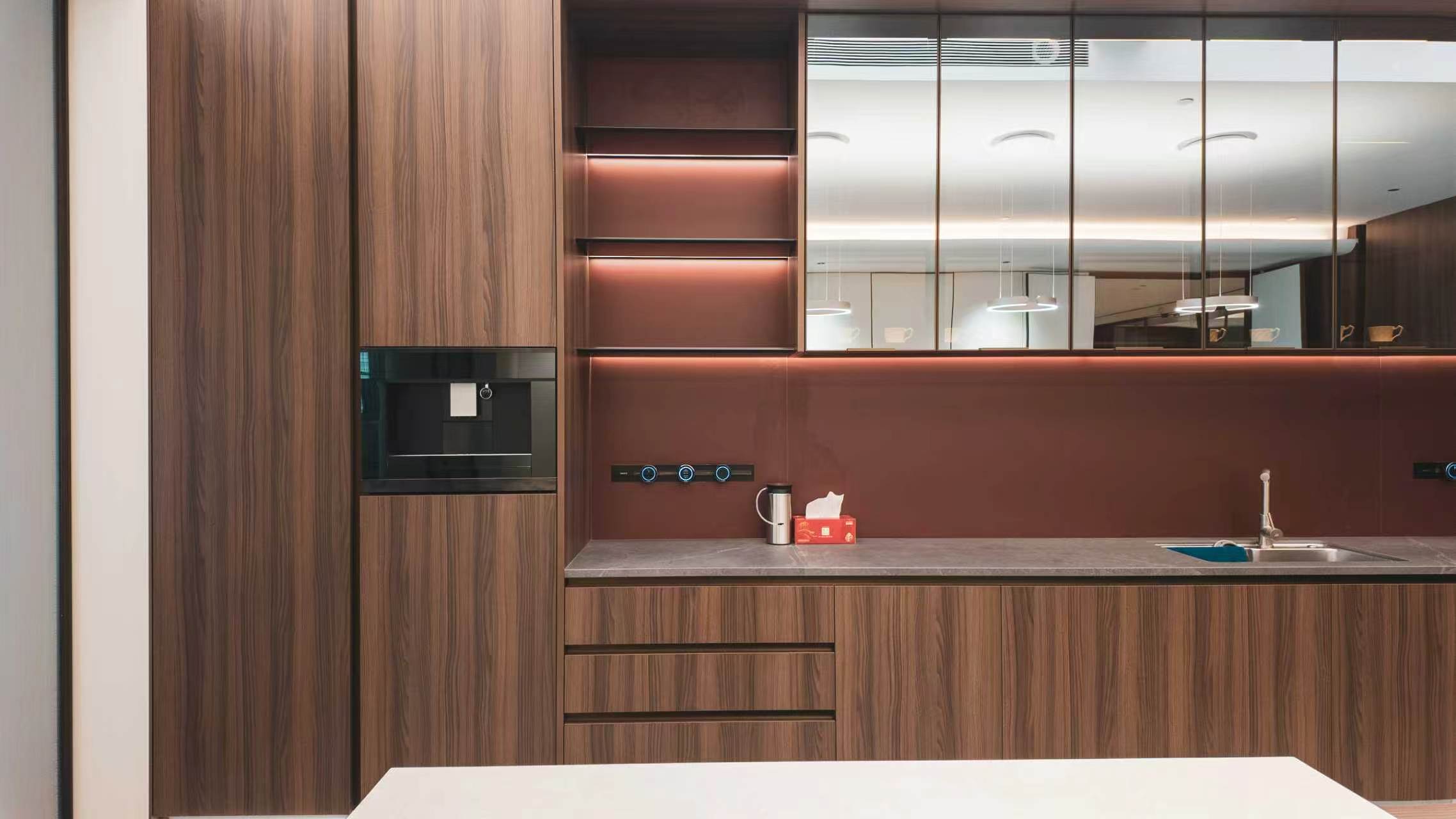
Cost accuracy begins before the material is selected. A supplier can price more reliably when the drawings identify the rooms, dimensions, cabinet types, finishes, appliances, lighting, site conditions and installation responsibilities. Missing information is normally handled as an assumption, allowance or exclusion.
Before comparing quotes, confirm that every supplier is working from:
· The same drawing revision and room-by-room joinery scope.
· The same site dimensions or clearly stated measurement assumptions.
· The same appliance models, service requirements and lighting scope.
· The same expectation for shop drawings, samples, packing and installation support.
A lower price can simply mean that fewer rooms, accessories or services have been included. Scope alignment should therefore come before any price negotiation.
Materials are a visible part of a custom cabinetry quote, but the product name alone does not define the cost. Substrate type, thickness, board grade, finish on the reverse face, edge treatment and required panel size can all affect the final specification.
Plywood, particleboard, oriented strand board and MDF have different machining characteristics and applications. The appropriate choice depends on the cabinet structure, door size, finish, moisture exposure, fixing requirements and destination standards. A more expensive board is not automatically the best choice for every component.
Melamine, PET, lacquer and natural wood veneer require different production processes. Natural veneer pricing is influenced by species, grade, sheet yield, grain selection and matching method. Lacquer cost is affected by colour, sheen, profile complexity, surface preparation and the number of finishing stages.
A professional quote should state the material reference or approval process. Natural materials will vary, so the aim is not to promise identical grain or colour. The aim is to agree how samples, grain direction, acceptable variation and adjacent finish transitions will be reviewed.
Explore BAODAO HOME’s material and finish options for examples of substrates, veneers, lacquers, decorative surfaces and edge treatments.

Hardware affects both cost and daily use. Hinges and drawer runners are only the starting point. Tall-unit mechanisms, pull-out baskets, lift systems, pocket-door hardware, wardrobe accessories, integrated lighting and motorised components can change a quotation significantly.
When reviewing hardware, ask the supplier to identify:
· Brand, series and exact model rather than a generic description such as imported hardware.
· Quantity and location of each mechanism.
· Door weight, drawer load and dimensional limits relevant to the selected product.
· Whether lighting drivers, sensors, transformers and destination-compatible electrical components are included.
Imported hardware is not automatically better for every application, and a recognised brand name does not remove the need to select the correct model. Performance depends on matching the hardware to the door size, load, opening action and installation conditions.
Standard rectangular cabinets are easier to repeat than architectural joinery with curved surfaces, integrated handles, framed glass doors, concealed connections or continuous wall elevations. These details add programming, machining, finishing, manual assembly and inspection time.
Common details that can increase manufacturing cost include:
· Curved doors, radius panels and transitions between curved and flat surfaces.
· Natural veneer grain matching across multiple doors or wall panels.
· Lacquered profiles, routed patterns and multi-stage colour finishing.
· Aluminium, glass, metal trim and timber components combined in one assembly.
· Mitred edges, integrated pulls, shadow gaps and concealed fixing methods.
· Door wall cabinet integration where reveals and material lines must align across systems.
The value is not in calling a product high end. It is in defining the detail, selecting a buildable method and checking that repeated components are manufactured consistently.

Technical detailing is often less visible than the finish, but it has a direct influence on cost certainty. Shop drawings translate the design into dimensions, sections, material junctions, hardware positions, appliance openings and installation details.
Complex projects may also require finish samples, veneer layouts, mock-ups, revision records and coordination with local architects, builders or MEP consultants. International projects can involve additional review cycles across time zones and different drawing standards.
Rather than asking whether design service is free, ask what the quoted service includes: the number of drawing stages, who approves them, how revisions are managed and what happens when site information changes after production approval.
Quality control adds factory time, but it can identify product-related issues before the joinery is packed and shipped. Useful checks may include component dimensions, surface condition, edge quality, drilling positions, hardware operation and the fit between related parts.
Pre-assembly should be matched to risk. A complex island, concealed door, feature cabinet or continuous wall system may justify a fuller trial assembly. Straightforward repeated cabinets may require component checks and representative assembly instead. It does not mean that every cabinet must ship fully assembled.
Pre-assembly also cannot compensate for inaccurate site dimensions, changed services, poor storage or unsuitable installation work. Its purpose is to verify manufacturing and assembly logic while corrections can still be made at the factory.
Read more about BAODAO HOME’s factory quality control pre-assembly and overseas shipping process.

The factory price is not always the delivered project price. Export packaging, freight, insurance, customs, local transport, unloading, storage and installation may be included, excluded or priced by different parties. Quotations cannot be compared fairly until these responsibilities are aligned.
Packing requirements also depend on the product. Finished lacquer surfaces, veneer panels, glass doors, long aluminium profiles and stone-related components do not have the same transport risks. Clear room or module labels, grouped hardware and a reconciled packing list support a more organised site handover.
For overseas custom joinery, clarify:
· The agreed delivery term and who is responsible for freight, duties and local transport.
· Whether crates, pallets or other protective packaging are included and suitable for the shipment method.
· Who unloads, stores and protects the joinery after arrival.
· Who installs the products and what drawings or guidance the local team will receive.
· How transit damage, missing items and site queries will be recorded and resolved.
When two quotations differ, the reason is rarely one item. The gap is usually created by a series of specification and scope decisions.
A description such as walnut cabinetry with imported hardware leaves critical questions unanswered. A comparable specification identifies the substrate, finish system, veneer approval, edge detail, hardware model and included internal accessories.
Shop drawings, samples, revisions, site coordination and installation information require time. If they are not included at the beginning, they may appear later as additional charges or remain the responsibility of the client and local contractor.
A simple front elevation may conceal curved substrates, metal reinforcement, pocket-door mechanisms, mitred construction or access limitations. Sections and details are needed before the factory can assess the real production method.
A factory collection price, an export-ready packed price and an installed project price are three different scopes. Freight assumptions, local labour and site readiness can make a larger difference than a small change in board cost.
Use the following checks before selecting a supplier:
· Issue the same drawing revision and written scope to every bidder.
· Compare the quotation by room, product or cabinet group rather than total price alone.
· Confirm substrates, finishes, thicknesses, visible edges and sample approval requirements.
· Record hardware by brand, series, model and quantity where it affects performance.
· Identify allowances, exclusions, optional items and assumptions that can become variations.
· Clarify the shop drawing process, revision responsibility and production approval milestone.
· Ask which items will be pre-assembled and what factory checks will be documented.
· Align packing, freight, unloading, installation and after-delivery responsibilities.
· Review payment terms, quotation validity, currency and tax or duty assumptions.
The aim is not to demand a supplier’s confidential internal cost calculation. It is to obtain a quotation with enough specification, scope and exclusions to understand what the project is buying.
BAODAO HOME develops custom kitchens, wardrobes, bathroom cabinetry, wall systems, interior doors and related joinery at its Foshan headquarters. The manufacturing base covers approximately 100,000 square metres and includes 15 production lines, dedicated finishing capabilities and a 3,000 square metre showroom. German-engineered processes, including Jowat PUR edge banding, support a broad range of panel and finish requirements.
For a project quotation, the useful starting point is a defined room-by-room scope supported by drawings, finish references, hardware requirements, appliance information, project location and programme. As information develops, the review can address material selection, technical detailing, manufacturing complexity, relevant factory checks, export packing and delivery responsibilities.
This does not make every price fixed before the design is resolved. It creates a clearer basis for identifying what is confirmed, what remains provisional and which decisions will affect the final custom joinery cost.
Learn more about BAODAO HOME’s Foshan manufacturing base and its integrated approach to custom cabinetry production.
Not in every project. Materials may be a major driver in straightforward cabinetry, while curved work, natural veneer matching, complex finishing, specialist hardware, technical detailing or international delivery can shift more cost into manufacturing and project services.
The suppliers may have interpreted the drawings differently or included different materials, hardware, technical services, factory checks, packing and installation responsibilities. Compare written scope and specifications before comparing totals.
No. The board must suit the component, finish, size and environment. Accurate machining, edge treatment, hardware selection, finishing, quality checks and installation also influence the completed result.
It should identify the rooms or products, quantities, main dimensions, materials, finishes, hardware, accessories, technical services, packing or delivery scope, installation responsibility, exclusions, assumptions and quotation validity.
Pre-assembly adds factory space and labour, so it is not a simple cost reduction. Its value is in finding relevant fit or function issues before dispatch, which may reduce avoidable correction work after delivery.
Send dimensioned plans and elevations, the project location, room-by-room scope, finish references, hardware and appliance requirements, site status, delivery expectations and target programme. Clear information produces a more useful quotation.
A strong custom joinery quotation makes the project easier to understand. It connects design information with materials, hardware, manufacturing, quality control and delivery responsibilities so the client can see what is fixed and what still needs a decision.
Planning a residential, hospitality or multi-unit project? Send BAODAO HOME your drawings, location, finish references and programme for a review of the joinery scope and quotation requirements.

Block Quote