
Why Do Some Minimalist Spaces Feel Luxurious While Others Feel Plain?
Discover what makes minimalist interiors feel truly refined. Explore how proportion, materials, color relationships, lighting, craftsmanship, and integrated cabinet-wall-door design create high-end minimalist spaces with depth, warmth, and lasting visual appeal.
August 27, 2026

Minimalism is not about simply reducing the number of things in a space. It is about making every detail more precise.

In modern high-end residences, minimalism has long been a popular design direction. Yet you may notice that some minimalist spaces feel calm, comfortable, and refined, while others, despite using the same white tones, wood finishes, and handleless cabinetry, can feel empty, cold, or even somewhat like a showroom.

The problem is often not that there are “too few things.”

Rather, it is this question: after everything has been reduced, what remains in the space?

As decoration is gradually removed, the elements that truly determine the quality of a space become proportion, materials, light and shadow, detailing, and the relationships between every individual element.

This is also one of the often-overlooked differences between high-end customization and ordinary customization: The simpler a space appears, the more demanding it is in terms of design and manufacturing.

In many high-end residential projects that Baodao Home has participated in recent years, greater emphasis has also been placed on this integrated design logic—coordinating doors, walls, cabinetry, and different materials so that minimalism becomes a true spatial order rather than simply a visual subtraction.
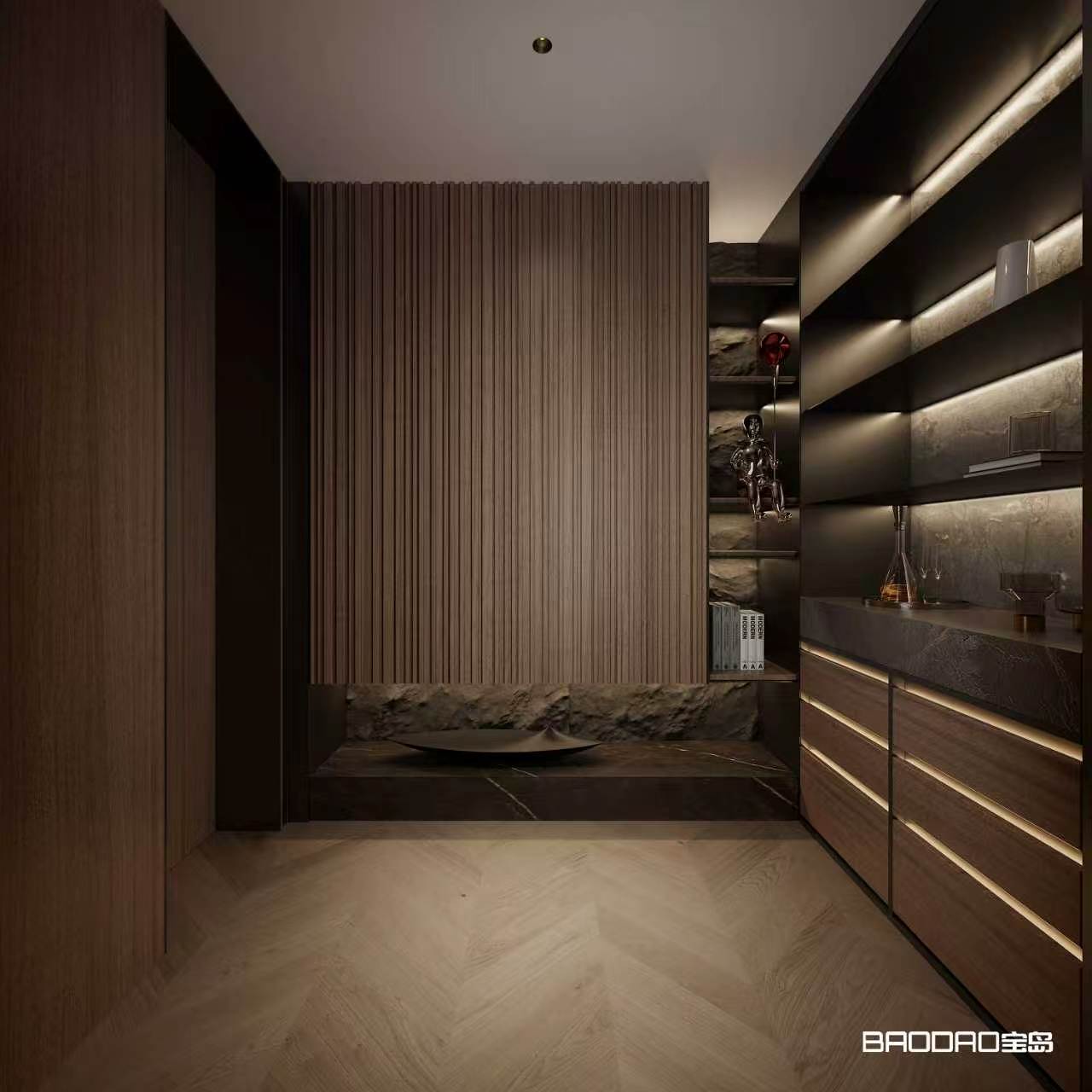
 

01|The First Principle of Minimalism: Not “Less,” but “Order”

One of the most common misunderstandings of minimalism is to interpret “reduction” simply as “removal.”

Reducing forms, colors, and decoration is not a problem in itself. However, if every element is simply treated with white, gray, and large flat surfaces, the space can easily lose depth. True minimalism places greater emphasis on a sense of order. If every cabinet door, open compartment, and decorative element has a different size and proportion, the overall result may still look chaotic even if expensive materials are used. Conversely, when cabinetry, walls, and door-wall systems share a unified proportional relationship, the space can achieve a very clean visual effect even without complex decorative forms.

Truly refined minimalism means that even after subtraction, people can still perceive: order in proportion, variation in materials, layers of light and shadow, and the warmth of everyday life.

What minimalism truly pursues is “less visual interference” and “greater spatial order.”


02|Materials Are the Key to Preventing Minimalist Spaces from Feeling Monotonous

When forms are reduced, the materials themselves become one of the most important forms of expression in the space.

Take the same wall, for example:

- Matte lacquer creates a sense of delicacy and purity;

- Natural wood veneer brings warmth and a natural character;

- PET/EB finishes emphasize modernity and a refined tactile quality;

- Aluminum, wood, and glass combinations add lightness and visual transparency;

- Leather can introduce a soft and warm texture to the space.

These materials do not require complicated forms. Differences in gloss, texture, touch, and color alone can create rich spatial layers.

Baodao Home offers a wide range of surface finish systems, including melamine finishes, lacquer, wood veneer, PET/EB, aluminum-wood glass, and leather. In actual projects, these materials can be combined according to spatial functions and design styles, rather than relying on a single material throughout the entire residence. A minimalist space does not have to use only one material. A truly refined approach allows different materials to connect with one another rather than compete for attention.
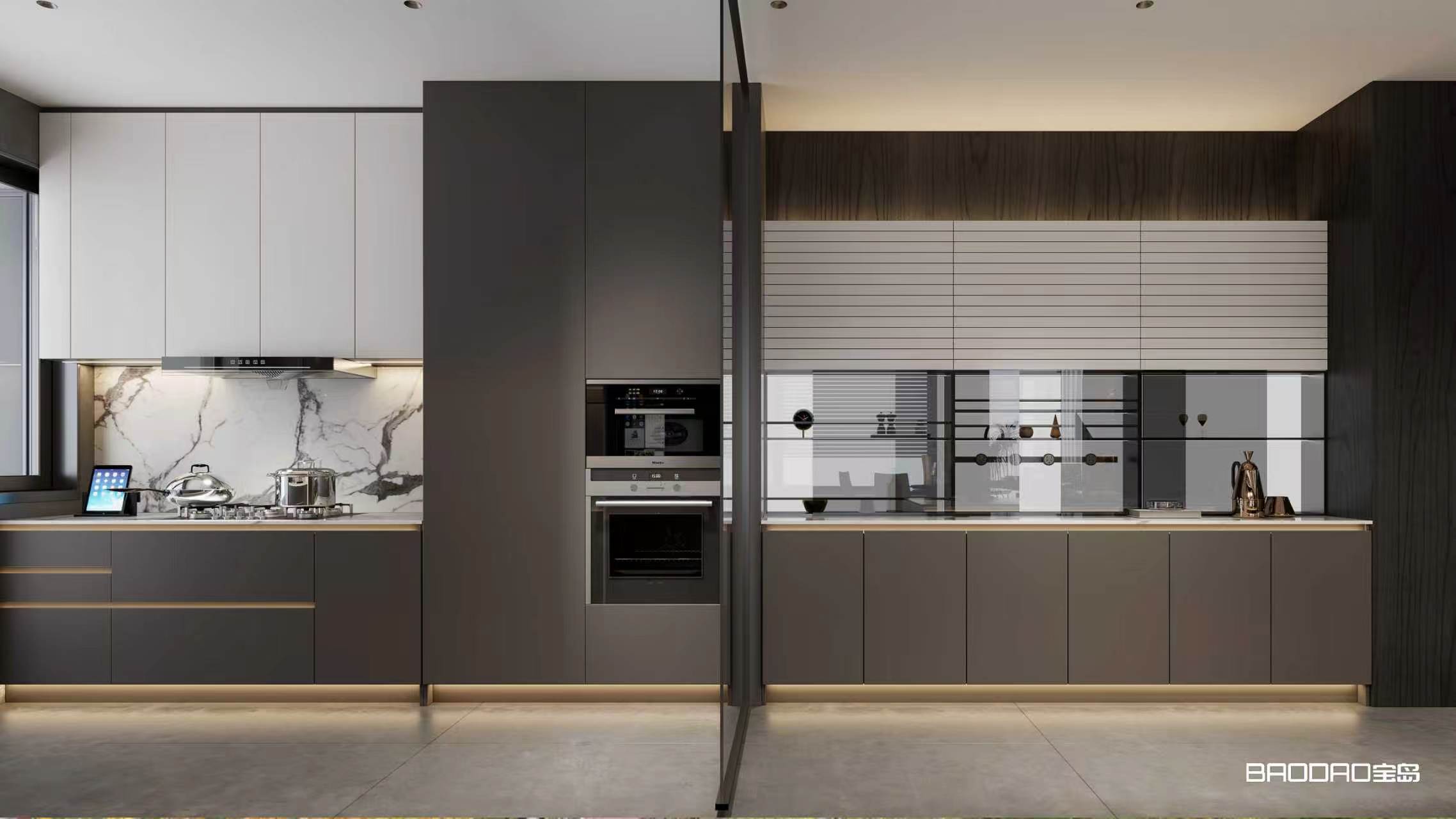
 

03|The Fewer the Colors, the More Important the Color Relationships

A minimalist space does not mean that only black, white, and gray can be used. On the contrary, low-saturation color relationships often make a space more enduring and visually comfortable.

For example:

- Warm white + light wood tones: creates a softer overall atmosphere, suitable for bedrooms, living rooms, and other residential spaces.

- Beige-gray + dark wood tones: creates a contrast between warm and cool tones while adding a sense of stability.

- ight gray + stone texture + black details: creates a more modern and rational visual character.

- What makes a space refined is not how many colors are used, but whether there is a clear hierarchy between them.

A space can be understood as a painting: The dominant color defines the atmosphere, secondary colors create depth, and small amounts of dark tones act as visual anchors.

If every color is competing for attention, minimalism naturally loses its sense of restraint.
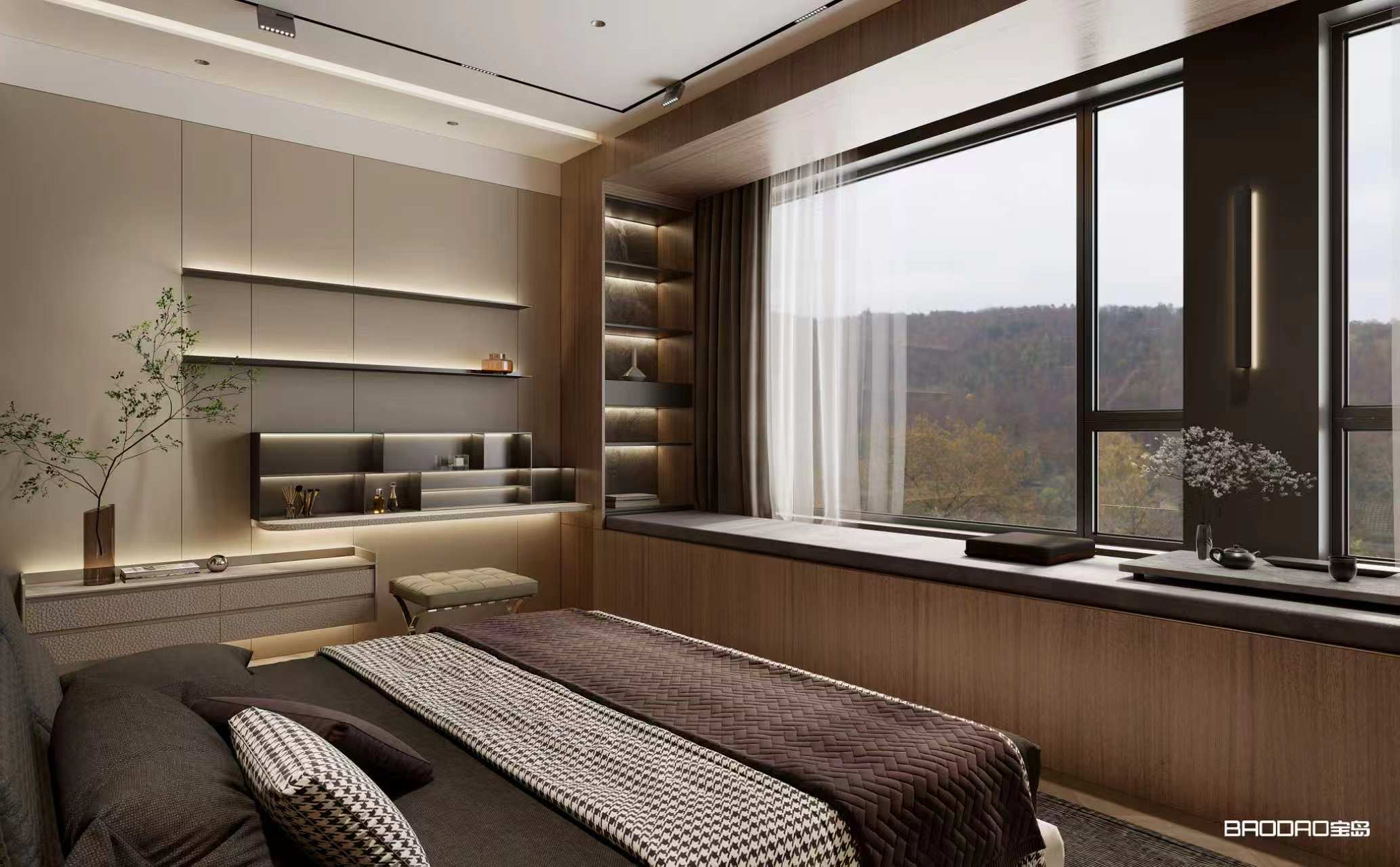
 

04|Light and Shadow Give Depth to Flat Surfaces

A sense of refinement often does not come from the lighting fixtures themselves, but from the changes created when light interacts with materials.

The same piece of wood veneer can show completely different textures under natural daylight and nighttime lighting. The same matte finish can also reveal subtle changes in brightness and shadow depending on the angle of the light. Therefore, in a minimalist space, lighting is not simply responsible for “illumination.”

More importantly, it shapes spatial depth and highlights material texture. If walls, cabinetry, and door panels can establish different relationships between light and shadow through concealed lighting, localized lighting, and natural daylight, the space can still create rich visual variation even without complex decoration. This is also why truly high-end minimalist spaces rarely pursue the idea of making the entire home uniformly bright. There should be light, but there should also be shadow; there should be negative space, but also depth.
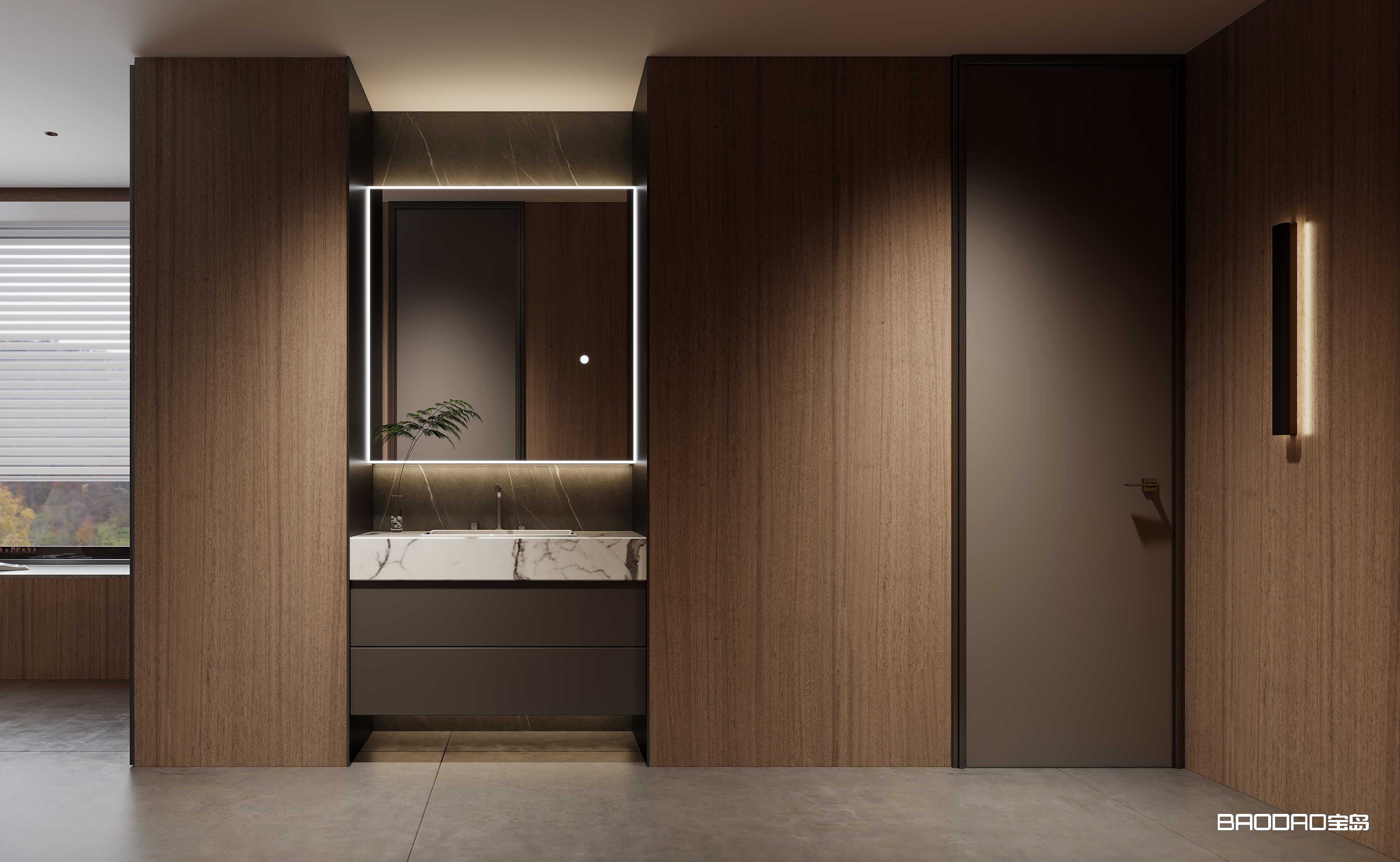
 

05|The Simpler the Design, the More Demanding the Craftsmanship

Minimalism also has a very practical characteristic: it leaves almost no room to hide problems.

Complex decorative forms can conceal certain details, but in minimalist spaces, large flat cabinet doors, continuous wall surfaces, and clean lines magnify panel flatness, dimensional accuracy, door gaps, edge banding, and installation details. Therefore, a space that appears to have “almost nothing” often requires far more precise manufacturing behind the scenes.

From panel cutting, edge banding, and drilling to sorting, trial assembly, and packaging, Baodao Home manages production through a digital manufacturing system and professional equipment. By using HOMAG production equipment and PUR edge-banding technology, together with digital production management and pre-assembly testing, the company standardizes both manufacturing and delivery processes.

The final result may appear to be nothing more than a simple cabinet door, a neatly aligned gap, or a clean junction.

Yet it is precisely these seemingly insignificant details that determine whether a minimalist space ultimately looks refined or ordinary.
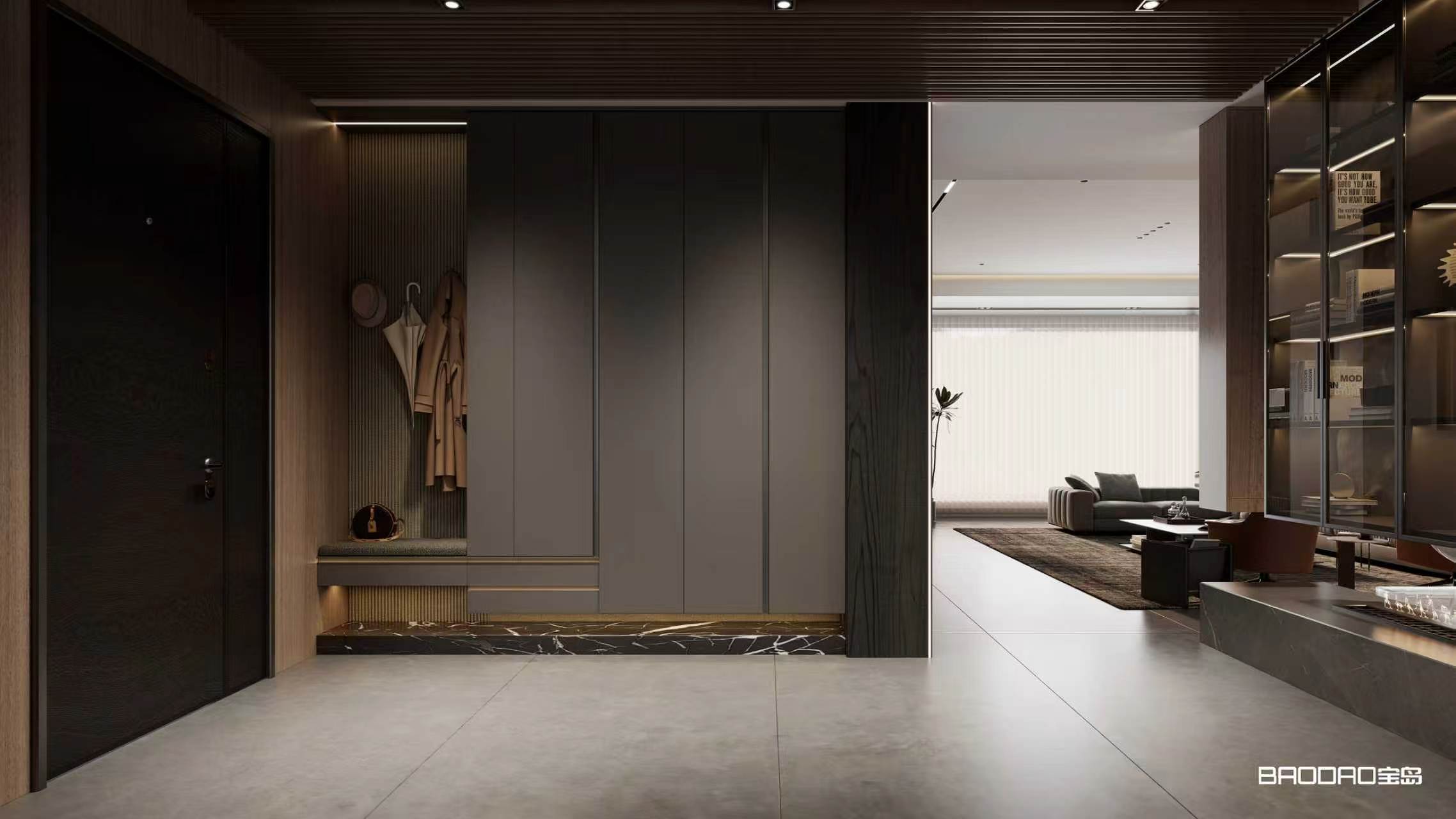
 

06|The Sophistication of Minimalism Ultimately Comes from Restraint

Minimalism does not mean that a space can only have one color, one material, or one form. Quite the opposite.

It requires designers to be more careful with every element:

- What should appear?

- What should be hidden?

- Where should space be left empty?

- Where should contrast be introduced?

- Which material should become the focus?

- Which details should simply remain quietly in the background?

This is also where the true value of high-end customization lies.
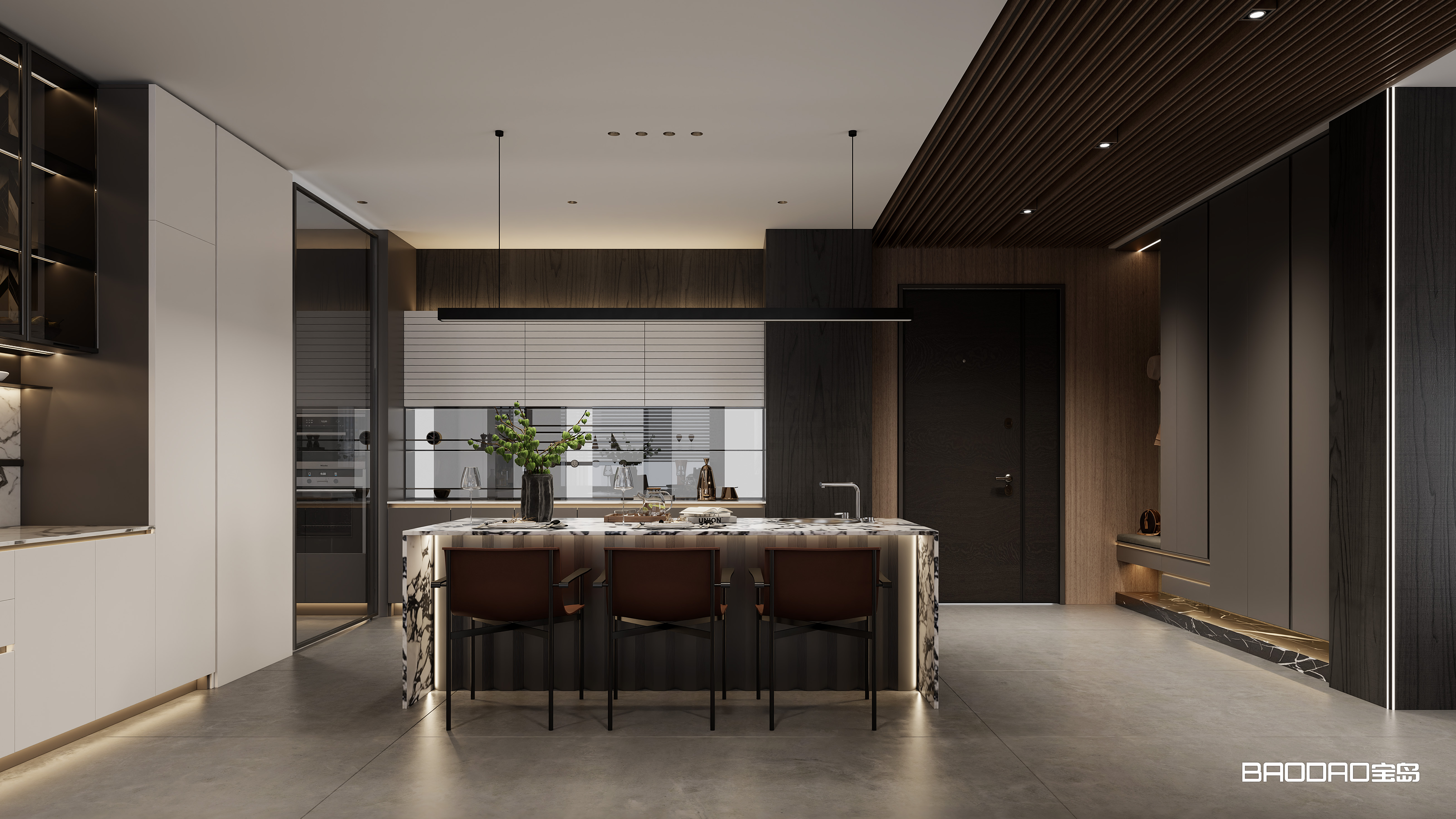
From core materials to surface finishes;

From proportions to structures;

From manufacturing precision to edge detailing;

From individual cabinetry to integrated cabinet-wall-door systems;

No element exists independently.

Truly high-end minimalism is never about making a space “have less,” but about ensuring that every element that remains has greater value.

Baodao Home’s understanding of high-end customization is also not about pursuing a single design style. Instead, it is about building a complete system from materials and design to manufacturing and final project delivery, allowing customization to become genuinely integrated with architecture and everyday life.

The final result may simply be a calm, restrained space without excessive decoration.

But when you actually enter it, you can feel the comfort of its proportions, the warmth of its materials, the changes in light and shadow, and the carefully balanced relationship between every detail.

That is where the true sophistication of minimalism lies.

Minimalism is not about simply reducing the number of things in a space. It is about making every detail more precise.

In modern high-end residences, minimalism has long been a popular design direction. Yet you may notice that some minimalist spaces feel calm, comfortable, and refined, while others, despite using the same white tones, wood finishes, and handleless cabinetry, can feel empty, cold, or even somewhat like a showroom.

The problem is often not that there are “too few things.”

Rather, it is this question: after everything has been reduced, what remains in the space?

As decoration is gradually removed, the elements that truly determine the quality of a space become proportion, materials, light and shadow, detailing, and the relationships between every individual element.

This is also one of the often-overlooked differences between high-end customization and ordinary customization: The simpler a space appears, the more demanding it is in terms of design and manufacturing.

In many high-end residential projects that Baodao Home has participated in recent years, greater emphasis has also been placed on this integrated design logic—coordinating doors, walls, cabinetry, and different materials so that minimalism becomes a true spatial order rather than simply a visual subtraction.


01|The First Principle of Minimalism: Not “Less,” but “Order”

One of the most common misunderstandings of minimalism is to interpret “reduction” simply as “removal.”

Reducing forms, colors, and decoration is not a problem in itself. However, if every element is simply treated with white, gray, and large flat surfaces, the space can easily lose depth. True minimalism places greater emphasis on a sense of order. If every cabinet door, open compartment, and decorative element has a different size and proportion, the overall result may still look chaotic even if expensive materials are used. Conversely, when cabinetry, walls, and door-wall systems share a unified proportional relationship, the space can achieve a very clean visual effect even without complex decorative forms.

Truly refined minimalism means that even after subtraction, people can still perceive: order in proportion, variation in materials, layers of light and shadow, and the warmth of everyday life.

What minimalism truly pursues is “less visual interference” and “greater spatial order.”


02|Materials Are the Key to Preventing Minimalist Spaces from Feeling Monotonous

When forms are reduced, the materials themselves become one of the most important forms of expression in the space.

Take the same wall, for example:

- Matte lacquer creates a sense of delicacy and purity;

- Natural wood veneer brings warmth and a natural character;

- PET/EB finishes emphasize modernity and a refined tactile quality;

- Aluminum, wood, and glass combinations add lightness and visual transparency;

- Leather can introduce a soft and warm texture to the space.

These materials do not require complicated forms. Differences in gloss, texture, touch, and color alone can create rich spatial layers.

Baodao Home offers a wide range of surface finish systems, including melamine finishes, lacquer, wood veneer, PET/EB, aluminum-wood glass, and leather. In actual projects, these materials can be combined according to spatial functions and design styles, rather than relying on a single material throughout the entire residence. A minimalist space does not have to use only one material. A truly refined approach allows different materials to connect with one another rather than compete for attention.


03|The Fewer the Colors, the More Important the Color Relationships

A minimalist space does not mean that only black, white, and gray can be used. On the contrary, low-saturation color relationships often make a space more enduring and visually comfortable.

For example:

- Warm white + light wood tones: creates a softer overall atmosphere, suitable for bedrooms, living rooms, and other residential spaces.

- Beige-gray + dark wood tones: creates a contrast between warm and cool tones while adding a sense of stability.

- ight gray + stone texture + black details: creates a more modern and rational visual character.

- What makes a space refined is not how many colors are used, but whether there is a clear hierarchy between them.

A space can be understood as a painting: The dominant color defines the atmosphere, secondary colors create depth, and small amounts of dark tones act as visual anchors.

If every color is competing for attention, minimalism naturally loses its sense of restraint.


04|Light and Shadow Give Depth to Flat Surfaces

A sense of refinement often does not come from the lighting fixtures themselves, but from the changes created when light interacts with materials.

The same piece of wood veneer can show completely different textures under natural daylight and nighttime lighting. The same matte finish can also reveal subtle changes in brightness and shadow depending on the angle of the light. Therefore, in a minimalist space, lighting is not simply responsible for “illumination.”

More importantly, it shapes spatial depth and highlights material texture. If walls, cabinetry, and door panels can establish different relationships between light and shadow through concealed lighting, localized lighting, and natural daylight, the space can still create rich visual variation even without complex decoration. This is also why truly high-end minimalist spaces rarely pursue the idea of making the entire home uniformly bright. There should be light, but there should also be shadow; there should be negative space, but also depth.


05|The Simpler the Design, the More Demanding the Craftsmanship

Minimalism also has a very practical characteristic: it leaves almost no room to hide problems.

Complex decorative forms can conceal certain details, but in minimalist spaces, large flat cabinet doors, continuous wall surfaces, and clean lines magnify panel flatness, dimensional accuracy, door gaps, edge banding, and installation details. Therefore, a space that appears to have “almost nothing” often requires far more precise manufacturing behind the scenes.

From panel cutting, edge banding, and drilling to sorting, trial assembly, and packaging, Baodao Home manages production through a digital manufacturing system and professional equipment. By using HOMAG production equipment and PUR edge-banding technology, together with digital production management and pre-assembly testing, the company standardizes both manufacturing and delivery processes.

The final result may appear to be nothing more than a simple cabinet door, a neatly aligned gap, or a clean junction.

Yet it is precisely these seemingly insignificant details that determine whether a minimalist space ultimately looks refined or ordinary.


06|The Sophistication of Minimalism Ultimately Comes from Restraint

Minimalism does not mean that a space can only have one color, one material, or one form. Quite the opposite.

It requires designers to be more careful with every element:

- What should appear?

- What should be hidden?

- Where should space be left empty?

- Where should contrast be introduced?

- Which material should become the focus?

- Which details should simply remain quietly in the background?

This is also where the true value of high-end customization lies.

From core materials to surface finishes;

From proportions to structures;

From manufacturing precision to edge detailing;

From individual cabinetry to integrated cabinet-wall-door systems;

No element exists independently.

Truly high-end minimalism is never about making a space “have less,” but about ensuring that every element that remains has greater value.

Baodao Home’s understanding of high-end customization is also not about pursuing a single design style. Instead, it is about building a complete system from materials and design to manufacturing and final project delivery, allowing customization to become genuinely integrated with architecture and everyday life.

The final result may simply be a calm, restrained space without excessive decoration.

But when you actually enter it, you can feel the comfort of its proportions, the warmth of its materials, the changes in light and shadow, and the carefully balanced relationship between every detail.

That is where the true sophistication of minimalism lies.

Start here to give your space a fresh new look.
By clicking “Submit”, I confirm I have read and agree to the
Privacy Policy
and consent to the processing of my personal data.
Thank you! Your submission has been received!
Oops! Something went wrong while submitting the form.
Button Text
Block Quote